Verified Heritage Guide | Fact-Checked Ground Team
Published by: Ujjain Darshan Editorial & Cultural Desk (Local Ground Team Since 2010)
Verified Against: MP Tourism Heritage Logs & Department of Archeology Timings | Updated: August 2026
Jantar Mantar Ujjain (Vedh Shala): Timings, Entry Fee, History & Instruments Guide
Built in 1719 by Maharaja Sawai Jai Singh II of Jaipur, Jantar Mantar (Vedh Shala) in Ujjain is the oldest of the five astronomical observatories constructed in India. Situated directly on the Tropic of Cancer, Ujjain was historically considered the prime meridian of Hindu astronomy. This living monument continues to measure solar time, planetary positions, and celestial declination with remarkable precision today.
🔭 Vedh Shala Details & Visitor Timings
| Key Details | Information |
|---|---|
| Built By & Year | Maharaja Sawai Jai Singh II (1719 AD) |
| Visiting Hours | 7:00 AM to 7:00 PM (Open 7 days a week) |
| Entry Ticket Fee | ₹40 for Indian Nationals | ₹200 for Foreign Tourists |
| Location | Chintaman Road, Near Shipra River, Ujjain (~3.5 km from Mahakaleshwar) |
| Geographical Significance | Located on the Tropic of Cancer ($23.5^\circ \text{N}$) | Historical Greenwich of India |
| Average Time Spent | 45 Minutes to 1 Hour |
1. Key Astronomical Instruments at Jantar Mantar
Samrat Yantra (Sundial)
The central, massive sundial calculates Ujjain solar time accurately based on the shadow cast by the sun onto calibrated stone quadrants.
Nadi Valaya Yantra
Consists of two circular plates measuring the sun’s position across the Northern and Southern hemispheres during equinoxes.
Digansh Yantra & Shanku Yantra
Used to determine the azimuth angle of celestial bodies and calculating exact seasonal variations during solstice events.
🔥 Special Offer: 50% OFF
Planning Your Ujjain Sightseeing Day?
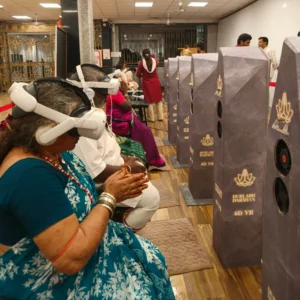
While exploring Jantar Mantar, Chintaman Ganesh, and Mahakal Lok, complete your spiritual trip by witnessing the famous 4:00 AM Bhasma Aarti ritual in life-like 3D/5D Virtual Reality near Mahakal Lok Corridor. Pre-book online to save up to 50% on VR tickets.
2. Travel Tips & Nearby Attractions
- Best Time for Sun-Dial Demonstration: Visit between 10:00 AM and 2:00 PM when direct sunlight creates clear shadows on the stone instruments.
- How to Reach: Located on Chintaman Road, about 3.5 km from Mahakaleshwar Temple. Easily accessible via e-rickshaw or taxi.
- Educational Experience: Informational boards explain how to read the stone scales. Local guides at the venue offer quick demonstrations for a nominal fee.
- Combine Circuit: Pair this visit with Chintaman Ganesh Temple (1.5 km further down the road) and Ram Ghat.
❓ Frequently Asked Questions
Why was Jantar Mantar built in Ujjain?
Ujjain has been the traditional center of Indian astronomy for centuries due to its location on the Tropic of Cancer. Raja Sawai Jai Singh II built Vedh Shala here to correct existing astronomical tables and calculate Hindu calendar (Panchang) dates accurately.
Does Jantar Mantar Ujjain still function today?
Yes! Unlike purely static monuments, the instruments at Ujjain’s Vedh Shala are still used by astronomers and scholars to prepare local ephemeris data and Hindu almanacs.
Is photography allowed inside Vedh Shala Ujjain?
Yes, mobile and personal camera photography is permitted within the observatory grounds.
🚗 Planning Your Ujjain Yatra & Vedic Poojas?
Our local travel desk and pandit network assist devotees with seamless logistics and authentic Vedic rituals in Ujjain:
- Authentic Dosh Poojas: Mangal Dosh Pooja, Kalsarp Dosh Nivaran, & Pitra Dosh Shanti by certified Ujjain Pandits
- Special Vedic Jaap Services: Navgrah Jaap, Mahamrityunjaya Jaap, & Maa Baglamukhi Anusthan
- Clean hotel accommodations within walking distance of Mahakal Lok Corridor
- Local taxi pickups/drops from Ujjain Junction and Indore Airport
- Customized 1-Day & 2-Day Temple Circuit Sightseeing Packages
7201092290
🛕 Visiting Mahakaleshwar?
Couldn't secure an early morning physical Bhasma Aarti pass at Mahakal? Experience the divine ritual in immersive 3D/5D Virtual Reality right inside the temple complex.
👉 Check VR Bhasma Aarti Timings & Slots